
Predictive social research
Before it
trends
Understand what people will think next.
Don't measure opinion. Anticipate reaction. A predictive sandbox built on real population data — revealing not just what people think, but what they expect others will think.
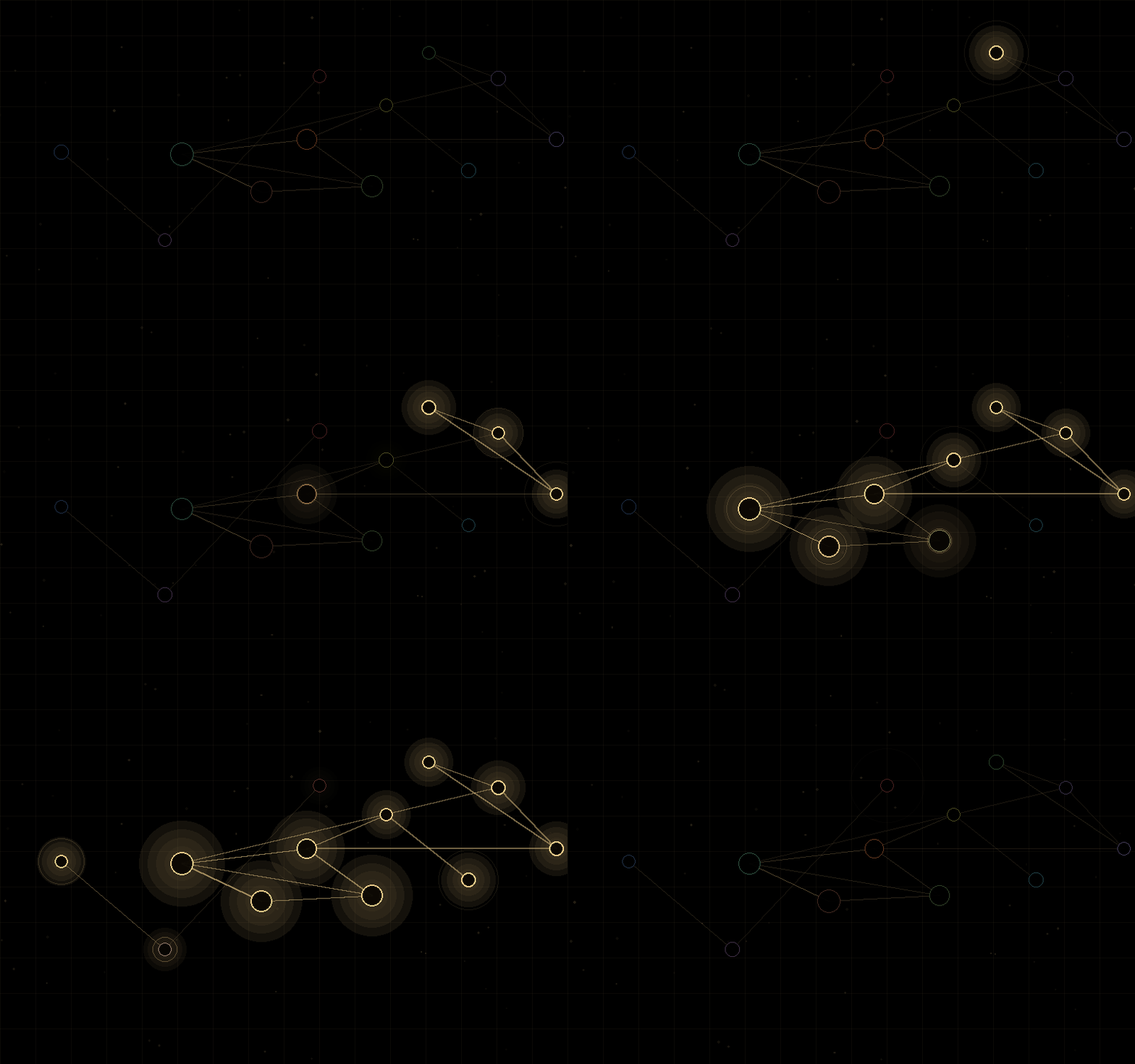
The problem
Traditional tools capture what people say.
Not what they're about to believe.
WHAT PEOPLE ACTUALLY FEEL
Stated opinions are shaped by social desirability. Pre-cognitive dispositions — stable, largely unconscious — determine how any message is received before conscious evaluation begins.
Social dynamics do not begin with opinion. They begin with expectation — what people believe others believe. Perceived norms, not observed opinions, drive social reality. This is the gap that conventional research cannot see.
WHAT THEY ARE ABOUT TO BELIEVE
Opinion formation is a process, not a snapshot. Standard surveys capture where people are, not where they are moving. The direction of drift is invisible until it becomes a headline.
WHAT THEY THINK OTHERS BELIEVE
The third-person effect is the engine of social change. People do not act on their own beliefs alone, but on their perception of what others believe. This perception gap is measurable — and predictive.
Perceived norms — not observed opinions — drive social reality.
What we do
BEFORE IT TRENDS
By modelling the attitudinal architecture of a real population — not a panel, not a sample — we identify structural vulnerabilities and emerging patterns weeks before they surface in conventional data.
ANTICIPATE REACTION
Test responses before events happen
Run scenarios through a living population model. See how different segments receive a message, a policy, an event — before it is released. Replace post-hoc analysis with pre-event intelligence.
MODEL EXPECTATIONS
Understand how people act on what they think others will do
Detect shifts before they become visible
The expectation layer is where reactions form. We make it visible — segment by segment, cluster by cluster — so you can act on the gap between what people believe and what they believe others believe.
14,536
REAL RESPONDENTS IN THE POPULATION MODEL
2020 – 2026
NATIONAL STUDIES
12
PREDICTIVE ATTITUDINAL TYPOLOGIES
91,978
SOCIAL NETWORK EDGES SIMULATED
You're not observing opinions.
You're observing how reactions form.
Built on real population data. Calibrated against the 2021 Census. Modelled on actual social networks. This is not a survey tool.